

How to calculate the stroke length of a pneumatic linear actuator?
Jun 12, 2025
Leave a message
Hey there! As a supplier of pneumatic linear actuators, I often get asked about how to calculate the stroke length of these nifty devices. It's a crucial aspect when it comes to selecting the right actuator for your specific application. So, let's dive right in and break down the process step by step.
First off, what exactly is stroke length? Well, in simple terms, it's the distance that the piston inside the pneumatic linear actuator can travel from its fully retracted position to its fully extended position. This measurement is super important because it determines how much movement your actuator can provide, which directly impacts the functionality of your system.
Now, there are a few factors that you need to take into account when calculating the stroke length. The first one is the application requirements. You've got to figure out what kind of movement your system needs. Are you looking to move a small object a short distance, or do you need to move something heavy over a longer span? For example, if you're using the actuator in a robotic arm, you'll need to know how far the arm needs to extend and retract to perform its tasks.
Another factor is the available space. You can't just pick an actuator with an insanely long stroke if you don't have the room for it. Measure the space where the actuator will be installed and make sure there's enough clearance for the full stroke length. You don't want the actuator to hit anything when it's moving, which could cause damage to both the actuator and your equipment.
Let's talk about the different types of pneumatic linear actuators. We've got the Air Piston Actuator. These are pretty common and work by using compressed air to move a piston inside a cylinder. The stroke length of an air piston actuator is usually determined by the length of the cylinder. The longer the cylinder, the longer the stroke.
Then there's the Fail Open Pneumatic Actuator. These are designed to open in case of a loss of air pressure, which can be crucial in safety - critical applications. When calculating the stroke length for a fail - open actuator, you need to consider the mechanism that allows it to open and close. This might involve additional components like springs, which can affect the overall stroke.
And don't forget about the Non - standard Spring Return Pneumatic Actuator. These actuators use a spring to return the piston to its original position when the air pressure is removed. The spring can add some complexity to the stroke length calculation because you need to account for the force exerted by the spring and how it affects the movement of the piston.
So, how do you actually calculate the stroke length? Well, if you're dealing with a standard actuator, and you know the physical dimensions of the cylinder, it's pretty straightforward. Just measure the length of the cylinder from the point where the piston is fully retracted to the point where it's fully extended. That measurement is your stroke length.
But what if you're dealing with a more complex actuator, like the ones with springs or special mechanisms? In that case, you might need to use some basic physics. You'll need to know the force exerted by the air pressure, the force of the spring (if there is one), and the mass of the object being moved.
Let's say you have an actuator with a spring. You can use Hooke's Law, which states that the force exerted by a spring is proportional to its displacement. The formula is F = kx, where F is the force, k is the spring constant, and x is the displacement. You'll also need to consider the force exerted by the compressed air, which can be calculated using the formula F = PA, where P is the air pressure and A is the cross - sectional area of the piston.
By equating these forces and solving for the displacement, you can get an estimate of the stroke length. But keep in mind that this is a simplified explanation, and in real - world applications, there are other factors like friction, which can affect the actual stroke length.
If you're still not sure how to calculate the stroke length for your specific application, don't worry. That's what we're here for. As a pneumatic linear actuator supplier, we've got a team of experts who can help you out. We can take a look at your requirements, the available space, and the type of actuator you need, and give you an accurate calculation of the stroke length.

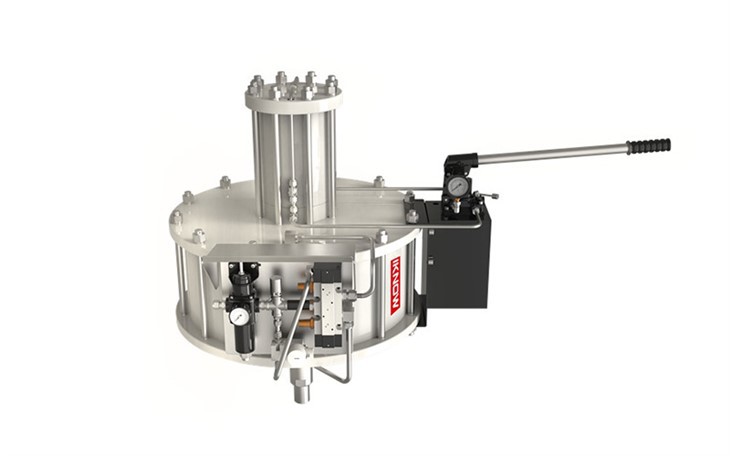
We also offer a wide range of pneumatic linear actuators, from standard models to custom - built ones. Whether you need a small actuator for a precision application or a large one for heavy - duty tasks, we've got you covered.
So, if you're in the market for a pneumatic linear actuator and need help with stroke length calculation or just want to explore your options, don't hesitate to get in touch. We're always happy to have a chat and help you find the perfect actuator for your needs. Let's start a conversation and see how we can make your project a success!
References
- "Pneumatic Systems Handbook" - A comprehensive guide on pneumatic actuators and their applications.
- "Engineering Mechanics: Statics and Dynamics" - A textbook that covers the basic physics principles used in actuator calculations.