


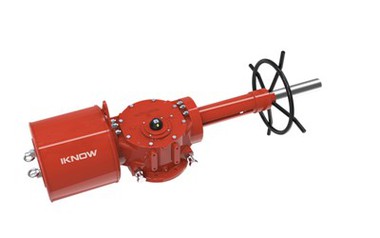
Your Leading Scotch Yoke Pneumatic Actuator Supplier
IKNOW insists on customer focus, providing one-stop pneumatic fluid solutions and personalized pneumatic actuator customization services to help customers achieve greater success. Our pneumatic actuator products, including RT -Series Rack & Pinion, ING-Series Scotch Yoke, ZH-Series Linear and other multi-series, have passed strict tests and have SIL3 certificates issued by TUV and many international certifications. A Scotch yoke pneumatic actuator is a mechanical device that converts the linear motion of a piston into a rotational motion, typically for operating quarter-turn valves.




Why Choose Us?
Rich Experience
Since 2006, IKNOW has been committed to the fluid control system of pneumatic actuators. With almost two decades in the industry, we have honed our expertise to deliver exceptional solutions.
Custom Service
We offer personalized services from cylinder selection to material choice, guaranteeing stable and efficient product operation in diverse environments, tailored to customers' needs.
Quality Guaranteed
We set up a professional product performance testing and inspection center, and standardize production in strict accordance with ISO9001 management system to ensure that each product can meet the actual needs of customers.
Wide Range of Applications
Our services cover construction, bio-medicine, fire fighting, water supply and drainage, petrochemical, metallurgy, paper, power and other industries, and have won unanimous praise from customers.
Specifications of Scotch Yoke Pneumatic Actuator
|
Actuator angle (adjustable range) |
Temperature range |
|
0°~90°(±6°) |
-46℃to149℃(-51℉to300℉) |
|
Maximum output torque of cylinder (5bar) |
Allowable air source pressure |
|
225364N.m |
2bar-10bar(29psi-145psi) |
|
Power source |
Control options |
|
Pneumatic |
Double acting |
|
Mounting |
Certifications |
|
ISO5211 |
SIL 3,CE |
|
Optional modules |
Valve Compatibility |
|
Pneumatic accessories, brackets |
Ball valve, butterfly valve |
|
Manual |
Customization |
|
NO |
Color, material, temperature |
Features of Scotch Yoke Pneumatic Actuator
High Force and Speed
One of the primary advantages of pneumatic actuators is their ability to generate high forces and rapid motion. By harnessing compressed air, these actuators can exert significant force, allowing them to handle heavy loads with ease. Moreover, pneumatic actuators provide quick response times, enabling rapid movement and high-speed operations in industrial processes.
Simple and Compact Design
Pneumatic actuators feature a straightforward design that is both simple and compact. This simplicity contributes to their ease of installation, operation, and maintenance. With fewer moving parts and a robust construction, these actuators offer reliability and durability, reducing the need for frequent repairs and replacements.
Cost-Effective Solution
Compared to other types of actuators, pneumatic actuators are generally more cost-effective. The components required for pneumatic systems are often less expensive than their electrical or hydraulic counterparts. Additionally, pneumatic actuators have lower energy consumption, resulting in reduced operating costs over the long term.
Wide Range of Applications
Pneumatic actuators find application in various industries due to their versatility. They can be utilized in diverse environments, including hazardous or explosive areas, as compressed air does not pose a fire hazard. Furthermore, these actuators are suitable for both linear and rotary motion, enabling their use in a wide range of systems and machinery.
Enhanced Safety Features
Safety is a paramount consideration in industrial settings, and pneumatic actuators offer inherent safety advantages. Since compressed air is the power source, there is no risk of electrical sparks, making them suitable for use in potentially explosive environments. Additionally, in the event of a power failure, pneumatic actuators will not lock up, allowing manual operation and ensuring continued functionality.
Installation Requirements of Scotch Yoke Pneumatic Actuator
Right Sizing of Pipes and Hoses
Use the correct pipe diameter and material to accommodate the air flow requirements. Undersized pipes can restrict air flow, causing increased pressure and potential failure, while oversized pipes can lead to system inefficiency. Ensure that all components are rated to handle the required airflow and pressure.
Secure Component Mounting
Mount pneumatic elements like pneumatic air cylinders, valves, and actuators correctly to avoid any movements that may cause damage or injury. Ensure that all parts are tightly screwed and no loose connection exists, for during operation, due to vibrations and movements, the parts may get loose or malfunction.
Seal Leaks Effectively
Leak detection during the installation procedure Always: The occurrence of leaks in pneumatic systems can waste energy, cause dangerous fluctuations of pressures and result in a compromise in safety on the whole of the entire system.
Usage of Scotch Yoke Pneumatic Actuator

Automotive:
Pneumatics handle clamping, positioning, and lifting.

Production:
Clear manufacturing lines and quality air system.

Food and Beverage:
Clean air systems in bottling, filling and packaging.

Packaging:
Precision in sealing, cutting, and sorting.

Construction:
Tools and systems to simplify heavy work.

Automation:
Valves and actuators that keep automated tasks running.
Ordering Process
Buyer sends inquiry
1
>>
Buyer receives quotation
2
>>
Order confirmation
3
>>
Buyer sends deposit
4
>>
Seller prepares
5
Packaging & Shipping
Packaging details: Protective film, standard export carton or wooden case.

FAQ
We're well-known as one of the leading scotch yoke pneumatic actuator manufacturers and suppliers in China. Please feel free to wholesale high quality scotch yoke pneumatic actuator from our factory. For price consultation, contact us.
pneumatic actuator upgrade, pneumatic actuator performance curves, oil free pneumatic actuator