

What is the difference between a linear and rotary fail open pneumatic actuator?
Oct 30, 2025
Leave a message
Hey there! As a supplier of fail open pneumatic actuators, I often get asked about the difference between linear and rotary fail open pneumatic actuators. So, I thought I'd take a few minutes to break it down for you in a way that's easy to understand.
Let's start with the basics. A pneumatic actuator is a device that uses compressed air to create motion. Fail open pneumatic actuators are designed to open automatically when there's a loss of air pressure, which is crucial in many safety - critical applications.
Linear Fail Open Pneumatic Actuators
A linear fail open pneumatic actuator moves in a straight line. It's like a piston in a cylinder. When compressed air is applied to one side of the piston, it moves the piston in a linear direction. In a fail open setup, when the air pressure drops, a spring mechanism kicks in to push the piston and open the valve or perform the required action.
One of the key advantages of linear actuators is their simplicity. They're easy to understand and maintain. For example, if you're dealing with a valve that needs to open in a straight - forward, on - off motion, a linear actuator is a great choice. They're also very precise in terms of the distance they can move. You can control exactly how far the piston moves, which is ideal for applications where you need to regulate the flow of a liquid or gas with high accuracy.
Another benefit is their durability. Since the motion is linear, there's less wear and tear on the components compared to some other types of actuators. This means they can last a long time, even in harsh industrial environments.
We offer a variety of linear fail open pneumatic actuators, such as the Non - standard Spring Return Pneumatic Actuator. This type of actuator is great for applications where you need a custom - sized or non - standard spring return mechanism. It gives you the flexibility to meet the specific requirements of your project.
The Direct Acting Actuator is also a popular choice. It's designed for applications where you need a quick and direct response. When the air pressure is applied, it immediately starts moving the piston, providing a fast and efficient operation.
And then there's the Air Piston Actuator. This actuator uses a piston and cylinder design to convert air pressure into linear motion. It's known for its high force output and reliability, making it suitable for heavy - duty applications.
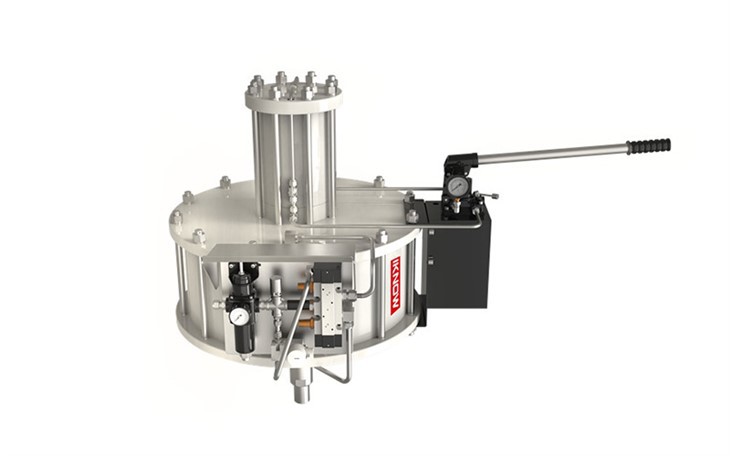

Rotary Fail Open Pneumatic Actuators
On the other hand, rotary fail open pneumatic actuators rotate around an axis. Instead of moving in a straight line, they turn a shaft or a valve in a circular motion. When air pressure is applied, the actuator rotates the shaft to a specific angle. When the air pressure is lost, a spring mechanism rotates the shaft back to the open position.
Rotary actuators are great for applications where you need to control the flow of a fluid or gas by rotating a valve. For example, in a pipeline system, a rotary actuator can be used to open or close a ball valve. They're also very useful in applications where you need to operate a device that has a circular - shaped component, like a damper or a butterfly valve.
One of the main advantages of rotary actuators is their ability to provide a large amount of torque. Torque is the force that causes an object to rotate. So, if you have a heavy valve or a large - scale device that needs to be turned, a rotary actuator can generate the necessary force to do it.
They're also very compact. Since they rotate around an axis, they take up less space compared to linear actuators in some cases. This is especially important in applications where space is limited, like in a small control panel or a tight machinery enclosure.
Key Differences
Now, let's talk about the key differences between linear and rotary fail open pneumatic actuators.
Motion: The most obvious difference is the type of motion. Linear actuators move in a straight line, while rotary actuators rotate around an axis. This means that they're suitable for different types of applications. If you need a straight - line movement, go for a linear actuator. If you need a rotational movement, a rotary actuator is the way to go.
Force and Torque: Linear actuators are better at providing linear force, which is useful for pushing or pulling objects. Rotary actuators, on the other hand, are designed to generate torque for rotating objects. So, if you're dealing with a heavy object that needs to be turned, a rotary actuator will be more effective.
Space Requirements: As mentioned earlier, rotary actuators are often more compact in terms of the space they occupy. Linear actuators, especially those with long strokes, can take up more space. So, if space is a concern, you might want to consider a rotary actuator.
Complexity: Linear actuators are generally simpler in design. They have fewer moving parts compared to rotary actuators, which can make them easier to maintain. However, rotary actuators can be more complex but offer more versatility in terms of the types of applications they can handle.
Choosing the Right Actuator
When it comes to choosing between a linear and a rotary fail open pneumatic actuator, it all boils down to your specific application. Here are some questions to ask yourself:
- What type of motion does my application require? Straight - line or rotational?
- How much force or torque do I need?
- How much space do I have available for the actuator?
- What is my budget for maintenance and parts replacement?
By answering these questions, you can make an informed decision about which type of actuator is best for your needs.
Why Choose Our Fail Open Pneumatic Actuators
As a supplier, we take pride in offering high - quality fail open pneumatic actuators. Our products are designed and manufactured to meet the highest industry standards. We use only the best materials and the latest manufacturing techniques to ensure the reliability and durability of our actuators.
We also offer excellent customer support. Our team of experts is always ready to help you choose the right actuator for your application. Whether you have technical questions or need advice on installation and maintenance, we're here to assist you.
If you're in the market for a fail open pneumatic actuator, whether it's a linear or a rotary one, we'd love to hear from you. We can provide you with detailed product information, quotes, and even samples if needed. Contact us to start the conversation and let's find the perfect actuator for your project.
References
- Pneumatic Actuator Handbook: A comprehensive guide to pneumatic actuators and their applications.
- Industrial Automation Magazine: Articles on the latest trends and technologies in pneumatic actuators.